This month, I am having coffee
with Angie Fox. I fell in love with Angie's series of the Accidental Demon
Slayer with its humor and adventure. Now she has come out with the first book
in a new series, and for some reason my mind keeps replaying two songs in my
head as I think about it: the theme song to M*A*S*H and Monster Mash. You will
quickly understand why.
Book Blurb:
No one patches up the incoming wounded like Dr. Petra Robichaud. Recruited by
the gods for her uncanny medical skills, she’s the best M*A*S*H surgeon in the
army. Along with a nosy guard sphinx, vegetarian werewolf, and other paranormal
paramedics, she bandages soldiers who are built like Greek gods (literally).
But when one sexy immortal ends up on her operating table—half dead and totally
to-die-for—Petra’s
afraid she’ll lose her patient and her heart…
Commander Galen of Delphi is one gorgeous
but stubborn demi-god. When his spirit tries to slip out of his fatally wounded
body, Dr. Petra has to slip it back in—unwittingly revealing her ability to see
ghosts. Now that Galen knows her secret, he’s convinced she’s part of an
ancient prophecy. If the oracles are right, Petra could lead Galen’s army to peace. And
if he seduces her on the way to hell and back? Heaven knows—all’s fair in
love and war…
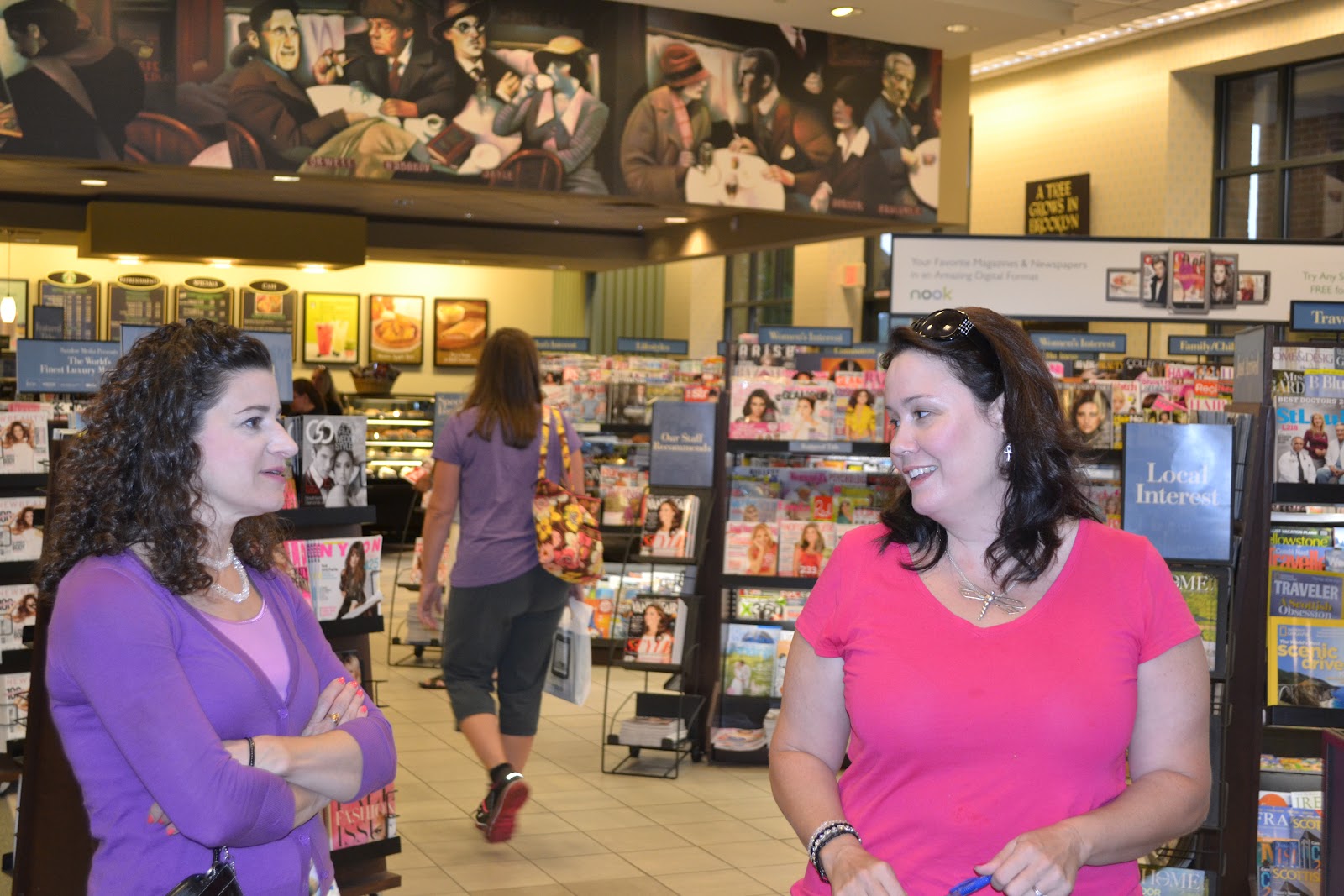
After the interview are pictures from the book launch of Immortally Yours.
David Alan Lucas: When you are starting to work on a new
novel, what do you find brings the story into focus for you? A Character? A
setting? Something else?
Angie Fox: I start with a kernel of an idea that amuses me. For example, the
Accidental Demon Slayer series began with a series of what-if’s. What if
a straight laced preschool teacher suddenly learns she’s a demon slayer? And
what if she has to learn about her powers on the run from a fifth level demon? Oh,
and wouldn’t it be fun if she’s running with her long-lost Grandma’s gang of
geriatric biker witches?
I started writing and let the storyline
evolve based on the characters and that central issue of what happens when a
reluctant heroine is thrust into a series of extraordinary situations.
I began the Monster MASH series by
wondering about all the things that could happen in a paranormal MASH unit. In
most paranormal books, characters heal themselves and that’s it. But what if my
world required paranormal doctors, nurses and medics to serve during a
paranormal war?
What if my protagonist is drafted
into the middle of this conflict? What if I gave her a vegetarian werewolf
roommate? Add in a vampire with an almost obsessive need for peace and privacy
(which you are just not going to get in a tent with two other people). What if
I give them a commander who is an old Spartan?
I let the storyline evolve based on
the interactions between characters and the impact of war on the soldiers, as
well as the MASH staff.
DL: What attracted you to Paranormal Fiction? Have you
always written Paranormal?
AF: I’ve always loved paranormals. In fact, I
remember discovering them back in college. In my sophomore year, there were six
of us, living in this tiny place. One night, my roommates started talking about
Interview with the Vampire. They were shocked I’d never heard of it and, like
the enablers they were, they managed to put together Ann Rice’s entire vampire
series, which they stacked next to my bed the next day. I picked up the first
book and wow. I was always a good student, but I skipped class for the next
week and read the series straight through.
Ironically, when I decided to
actually try and write a book of my own, I completely ignored my love of
paranormals. Because, you know, that makes sense. I decided to write
mystery/suspense with lots of science and research involved. I’d outline, I’d
write pages and pages of character notes, I’d force myself to do those little
note cards. And I hate note cards. In retrospect, I was fighting my voice. When
I was about ready to go insane, I’d sneak off and read Jim Butcher, Anne Rice
or Kerrelyn Sparks, just to catch a break.
It took three unpublished books for
it to click and for me to realize that hmm…maybe I should write the kind of
books I love to read. I had this spark of an idea about a preschool teacher who
is forced to run off with a gang of geriatric biker witches and The Accidental Demon Slayer was born.
Instead of a 20-page plot outline, I had a 5-page list of ideas, one of which
included “but little did they know, all the Shoney’s are run by werewolves.”
Instead of following the rules, I broke a few. Instead of painstakingly writing
over the course of a year, I grinned my way through the book and had a complete
manuscript in five months.
The opening chapters did well in
contests and caught the eye of Leah Hultenschmidt, who asked to see the whole
thing. Leah bought the book less than a week after I finished it. And I didn’t
write one single note card.
DL: What key things make your stories work?
AF: Like with any
story, I think you have to make sure characters are both dynamic, and
down-to-Earth. They have to be doing things, learning things, exploring issues that
are exciting and new and make us want to turn the pages. Yet, we need to be
able to relate on a fundamental level to their very real struggles.
One of the challenges – and the
great joys – of writing Immortally Yours was balancing the humor with the stark
tragedy of war. The darker emotional context makes the light moments even
funnier, and works to lend entire tone of the book a nice texture and more
depth.
Petra
and her colleagues at the MASH 3063rd have been drafted until the
end of the war, which is bad for Petra
but even worse for people like her vampire roommate, Marius. They’re living in
this quirky, ad-hock camp, trying to make the best of it while they work long
hours in the OR, putting soldiers back together – knowing that they’re probably
going to see these injured heroes again and again – if they’re lucky.
The underlying tragedy brings the
oddball personalities in the camp together. They develop ways to keep their
sanity and to create the kind of relationships that offer a port in the storm.
DL: What themes in your fiction writing seem to drive you
the most?
AF: I tend to write
about characters who struggle against the system, and the powers who
tell them who they “should” be. In the Monster MASH series, I also tackle
everything that drives me crazy about mindless government, bureaucracy and the
seemingly insurmountable forces that seek to control our daily lives.
It’s about people who stand up,
despite the odds, and take that control back. Plus, Immortally Yours was simply
a fun book to write. It was a great challenge to construct a new world that is
starker than ours, yet holds many of the same challenges.
DL: Do you work on multiple novels at once? If so, how
many?
AF: Ha! No. I wish I could work on more than one
project at once. Alas, I can’t even write on a novel and a book proposal at the
same time. My brain has tunnel vision that way. I think it has a lot to do with
the fact that I’m always subconsciously working on story ideas, and I need to
focus that energy.
DL: How easy was it to take the leap of faith to become a
serious writer and chase this career? What did you find that you had to do to
take the step?
AF: It was extremely
hard and it took me many years to do it. It takes a lot of faith to stay home
and work on a chapter while everyone else is out enjoying a pretty day or going
to the movies.
As far as what I had to do to take
the next step: I had to decide to do it. I even asked for my husband’s buy-in,
because I knew if I got serious about my writing and actually stuck with a
writing schedule, it would take time away from him.
Then – and this was hugely
important for me (as well as a struggle) - I had to let go of the idea that
everyone was going to cheerlead me and tell me how great it was that I was writing
a book. The truth is, most people will not understand it at all. And here’s a
secret that you may not want to know: even if you hit the New York Times list,
people will still not understand why you do what you do.
The people who are closest to you
will tend to be the ones who care the least about your writing. That’s just the
nature of relationships. There’s nothing wrong with it. It’s just what is.
But here’s the key: you can’t
write hoping to gain the approval of other people. On the other hand, you can’t
always write for the pure joy of it because sometimes, it’s really hard to sit
down in front of that computer. Writing is something you do because it fulfills
you on an entirely different level. And when it does work – wow – it’s like
nothing else in the world.
DL: When you plot your novels, from whose point of view do
you plot from? The protagonist’s? The antagonist’s? The narrator’s? Some one
else?
AF: I do it from my
point of view – what I’d like to see happen to these characters. If I
let my protagonists plot their own novels, they’d take the easy way out.
DL: What novels, books, articles, magazines or other media
most useful when you are researching your novels?
AF: It depends on the
novel. For the Accidental Demon Slayer series, the best research I ever did was
to ride around with Harley bikers. It made my biker witches so much more
realistic.
For Immortally Yours, I spent a
lot of time learning about how MASH camps operate. I also called up my nurse
and doctor friends and asked them questions like: if I was going to make a
banshee do X, Y and Z, by how much would I need to increase normal lung
capacity? And what does that mean physically? How would they look different?
Sound different?
And then I watched Patton to get a
feel for my camp commander (and because I like Patton).
Research really does vary from
book to book. There’s no one “right” way to do it. It’s all about what inspires
you and enables you to write a better book.
DL: What is your writing schedule like?
AF: I write in the
mornings for about four hours. The afternoon is spent on research or on emails,
reader correspondence and interviews like this one.
DL: If you could have coffee (or drink of your choice) with
four other authors from any time period, who would you choose and why?
AF: I’d like to have a beer with Edgar Allen Poe (because I’ve
read everything he’s written and definitely owe that man a drink), Jeff Shaara
(you know he’d have amazing stories), Charlaine Harris (she has such a great
sense of humor) and Malcom Gladwell (so I could debate his theories with him –
plus, I’m betting he’s even more fascinating in person).
DL: Many authors focus on social media and other creative
marketing strategies. How do you promote your books?
AF: I’m all about creative marketing. It’s fun and my brain just
thinks that way. For the Accidental Demon Slayer series, I developed the What’s
Your Biker Witch Name quiz? It went viral, which has been a blast. You haven’t
lived until you get emails from physicists in China telling you that their biker
witch names are things like Wino Wally No Brakes and Two Date Tessa Hard Rider.
And now for a shameless plug: you can get your biker witch name at: www.angiefox.com.
For Immortally Yours, I’m doing a
quirky little viral program that is cracking me up right now because it is
getting slightly out of control (which in my world, means things are going well).
I’m offering readers an interactive experience that centers around the news
network that is covering the war.
In this new series, PNN is the
paranormal version of CNN. So I’m basically setting up the “official” PNN
website to be like The Onion, only paranormal. It allows me to have a blast,
while giving readers a taste of the series and immersing them in the world of
PNN. Plus, it’s an entertaining way to poke fun at the love/hate relationship I
have with 24-hour cable news. Check it out at www.PNN-Network.com
DL: How could my readers learn more about you?
AF: Just visit www.angiefox.com.
I’m running a contest right now where you could win naming rights to a character
in my next Monster MASH book. It’s up on my blog.
Thank you Angie Fox!
How do you win a free copy of this book? To enter
the contest, simply leave a comment or question on the Writers' Lens blog
between now (September 1, 2012) and midnight September 30, 2012. Please
include your email so we can reach you if you win. The more comments you leave,
the greater your chance of winning the contest. If you refer others to The
Writer's Lens who mention your name in their comments, I'll enter your name
again in our random number generator along with theirs, also increasing your
chances at winning! The winner will be chosen after midnight on Sunday, September
30 and the announcement made on Monday, October 1. Good luck and comment often.
Thank you for reading and please visit www.davidalanlucas.com and www.thewriterslens.com.
You can also follow me on twitter @Owlkenpowriter and the Writer’s Lens
@TheWritersLens. Fiction is the world where the philosopher is the most free in
our society to explore the human condition as he chooses.